Before it becomes fuel that you can put into your car, a barrel of crude oil has passed through many agents. It starts as oil contained in the reserve located hundreds of kilometres below the earth’s surface, is extracted, brought to the surface and processed by the rig crew, and is transported via pipeline, terminals, and tank farms to be refined into gasoline, diesel, and kerosene and is finally sold per litre at the filling station. The upstream, midstream and downstream processes can be identified and defined as three different environments with varying companies usually doing their business independently.
There is an essential need to fill a gap identified in the company’s offerings by means of the Oil ERP suite. The ERP suite is based on the Odoo program and contains more than thirty modules that are connected with various stages in the value chain, using the same resources, people, inventories, and accounting documents. The information about agreements is used to determine the amounts of royalties, the data about well testing is included in the output dashboard, and the sale at the gas station is automatically recorded in the accounting books.
Understanding the Oil & Gas Value Chain
The oil and gas industry's value chain consists of three primary stages. The upstream phase includes the search for hydrocarbons and their production. In this stage, rights for hydrocarbon extraction, drilling, and production of crude oil and gas are obtained. At the midstream stage, the connection between production sites and processing plants is established by means of oil/gas transportation through pipelines, tanks, terminals, and storage facilities. Finally, in the downstream stage, crude oil is converted into various petroleum products, including gasoline, diesel, jet fuel, and lubricants, which are subsequently transported to customers through the relevant distribution channels.
Although the three sections perform completely different tasks, they are all interconnected through the barrel. The amount of processed crude provided by upstream determines how much product midstream measures and stores; downstream works solely with the oil supplied by the previous stages. Each section has its own assets, risks, and often its own companies. This is why upstream and midstream figures are usually recorded in separate systems, requiring their users to perform data entry two times. The solution to the above problem is to implement an ERP system.
Upstream: Where the Barrel Begins
The process of producing money and barrels consists of the various stages of geological exploration and extraction of hydrocarbons, including searching for favorable locations for drilling, acquiring the rights to drill at those sites, preparing the wells, and transferring crude oil and gas to the surface from them over the course of several years. The first factor used in determining the actual production at this stage includes estimations of reserves, testing data obtained as a result of well testing, volume of production, and conditions of the lease. It is the most investment-intensive operation in oil production with the added speculative risk. The Reservoir, Lease, Well & Drilling, SCADA, and Production Optimisation modules included in the Oil ERP suite, as well as Royalty and Joint Venture, are responsible for ensuring proper management of the processes.
Reservoir Management
The geography, porosity, permeability, drainage basin, and net pay thickness are supplied by the Reservoir module, which also gathers information about commercial features. Everything starts with the underground. The record has its own lifecycle, which is linked to the field project and lease in terms of the Exploration & Appraisal, Production/Active, and Depleted and Abandoned phases.
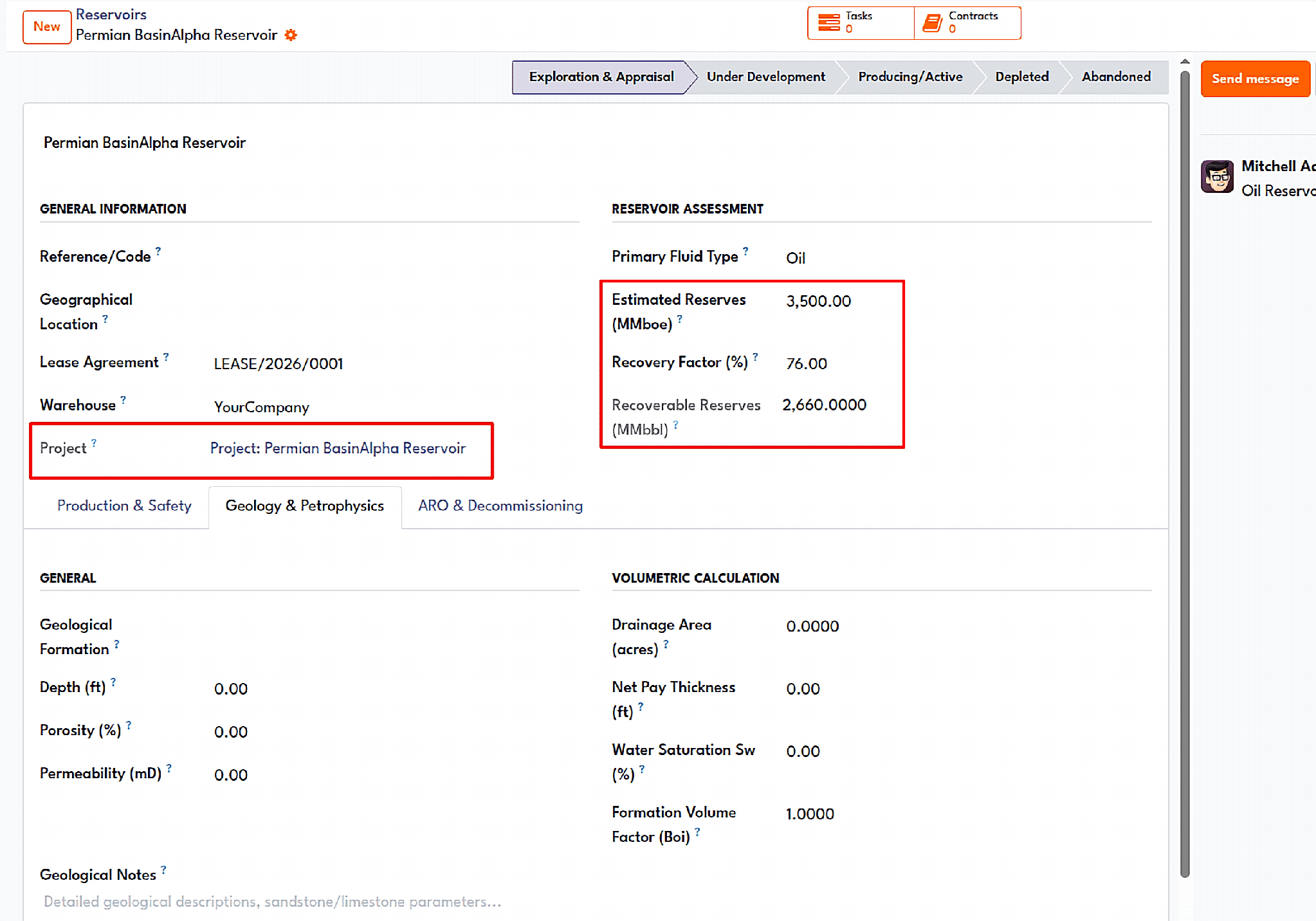
A reservoir record with estimated reserves, recovery factor, and links to its lease and project.
Well & Drilling
When the time to drill comes, the rig, the offshore platform, and the position for storing the equipment on the deck are adjusted according to the distinctive characteristics of the well. The buttons at the top are used quite frequently: Plug & Abandon, when a well reaches the end of its active life; Record Production, when the amounts being produced by the well are registered; and Start Drilling, which moves the well’s status from Planned to Drilling. The well page is a key record of all the actions taken on the well, as various reports and expenses are stored as smart buttons.
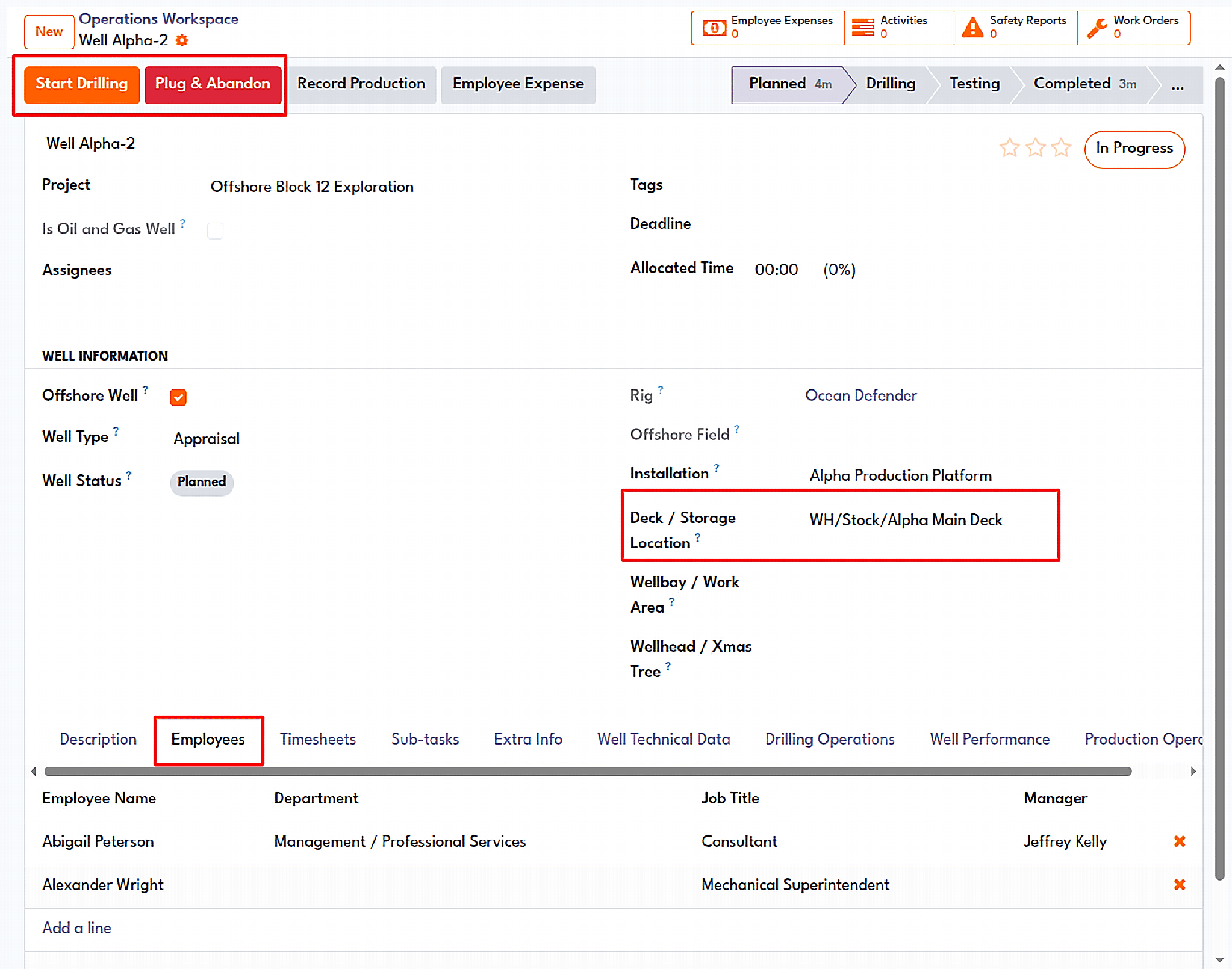
Well Alpha-2 on the Ocean Defender rig: Start Drilling moves it through the Planned, Drilling, Testing and Completed stages.
SCADA & Production Monitoring
Moreover, current operational data can be connected to prior operations. After a SCADA Integration module makes an API connection with an Ignition server, every sensor will be treated like a tag in the register, associated with a well name and a record value for readings, including pressure, temperature, flow rate, vibration, valve position, and cumulative volume. Thanks to those identifiers, the Odoo models receive information from sensors without the need to retype figures.
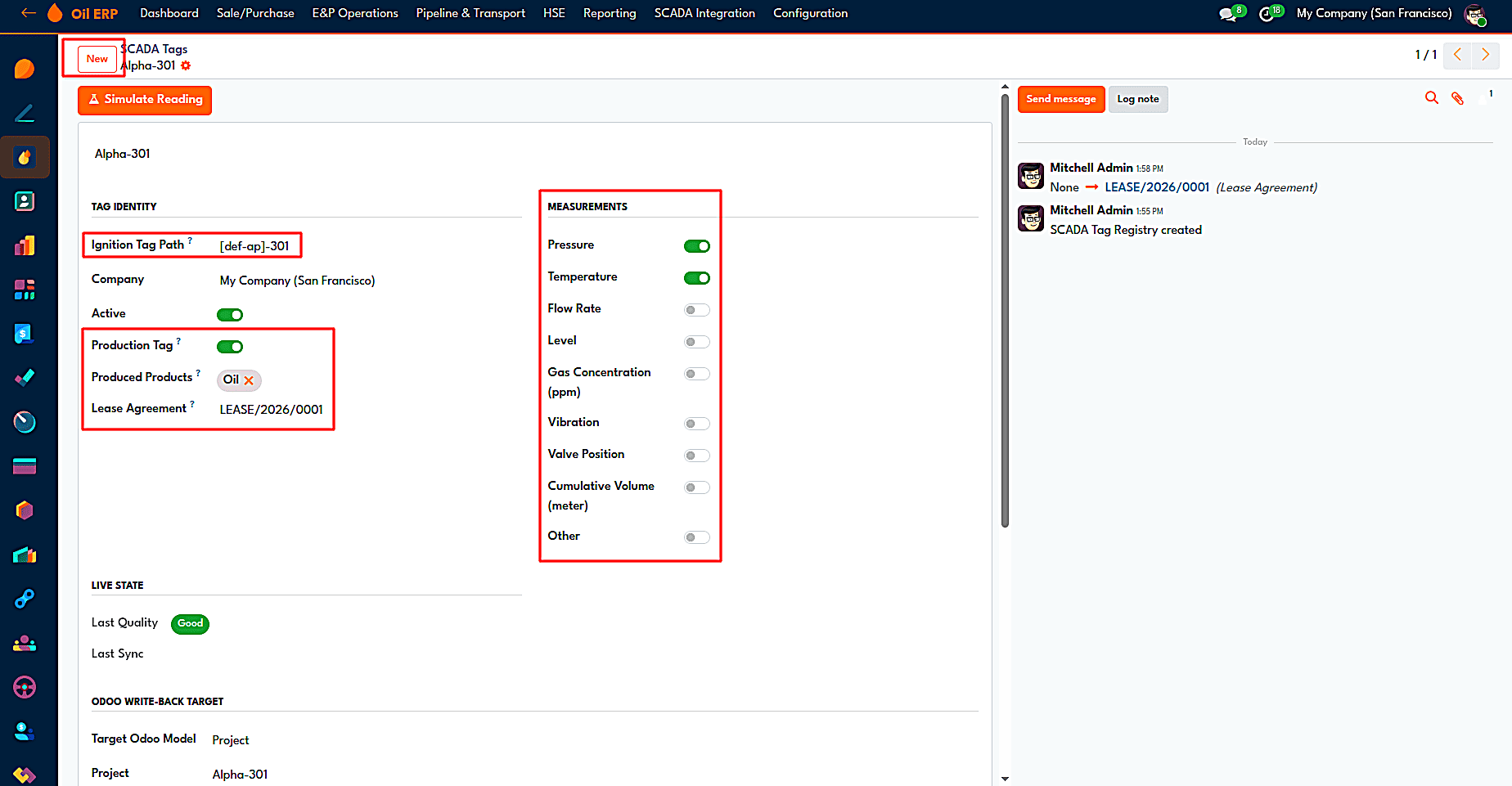
A SCADA tag registry entry mapped to an Ignition tag path, with measurement toggles and an Odoo write-back target.
Production Optimization
Production Optimisation keeps track of the outputs of these tags. Every well features a Performance versus Target section, and the one below shows current performance is 56% below target. An economic engine for this will provide advice in simple terms. It reads "Intervene" since it falls below economic limits. For weekly review purposes, lost production information gets inputted into intelligence views of the module.
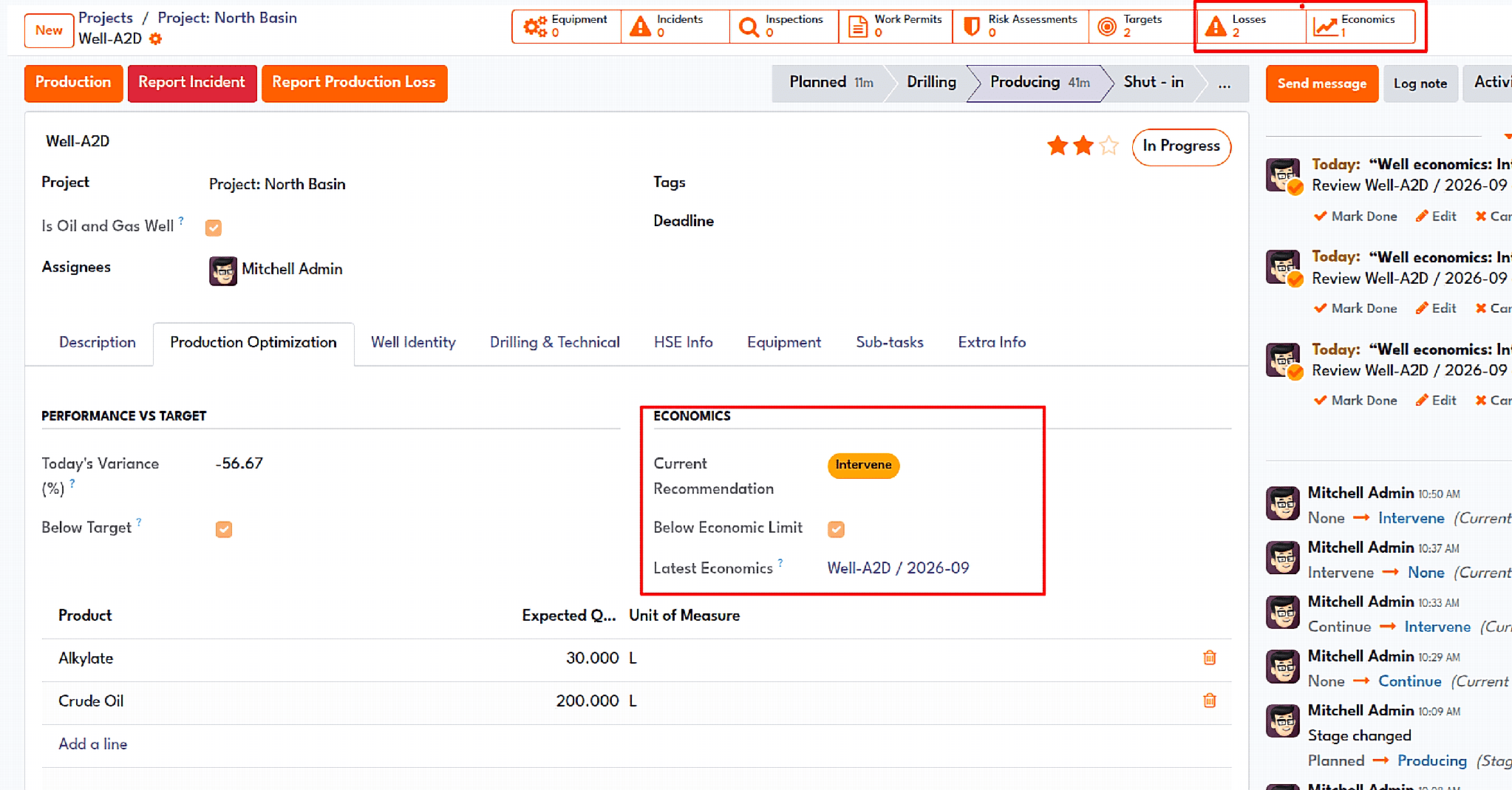
The Production Optimisation tab flags Well-A2D below target and recommends intervention.
Commercial modules function quietly around the wells. Lease Management takes care of contracts and documents, while the Royalty module handles payments based on these leases. At the same time, the Joint Venture module ensures that paperwork relating to JOA is properly executed by handling AFE approvals, monthly cash calls, and shared interest billing. The rest of the upstream picture is formed by calculations related to field projects, equipment, and labour costs.
Midstream: Keeping the Barrel Moving
Crude oil is part of midstream since it is transported from the starting point towards the refining facility because midstream's work is mainly concerned with product movement. This sector includes pipelines, trucks for oil transportation, terminals, storage tanks, and measurement, which is an unorthodox but necessary factor for conversion of units into standard conditions so that everybody, including for payment, checks, and custody transfer, will have the same information. This consists of Fleet Live Tracking, Gate Pass, Transfers and Custody Transfer, Pipeline Delivery Methods, and the HPC module that uses the methods of measurement of the Oil ERP software.
Pipeline Operations
The Pipeline module introduces a pipeline option to the delivery methods available in Odoo. With respect to fleet and freight, pipeline shipments are regarded as primary entities once the Oil and Gas Pipeline is set as a delivery method and the pipeline operator is specified. The role of measurement standards is crucial here. Indeed, the presence of ASTM D1250 volume correction groups and requirements in the HPC module allow for the conversion of quantities; these were what the inspectors were expecting to see.
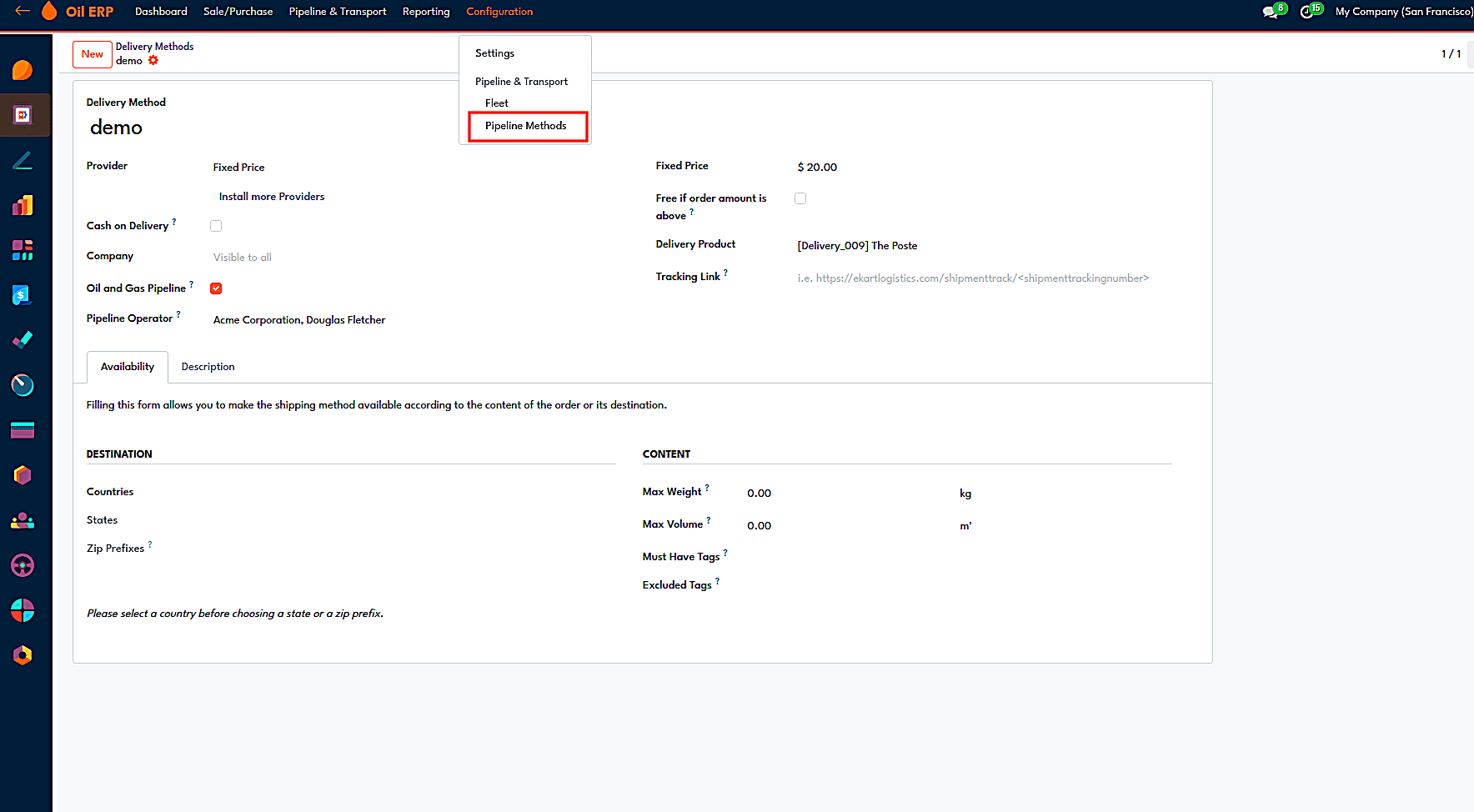
Marking a delivery method as an oil and gas pipeline, with the pipeline operator assigned.
Custody Transfer
The Custody Transfer Module is responsible for representing real ownership transfer. The product is transferred through the Draft stage to Approved, then to In Progress and finally to Completed stage with approvals along the way after it has changed place during the stock selection process. Every line in the document gets corrected volume factors calculated from product configuration in such a way that both sides transfer identical liters. The module keeps the information that the auditor needs such as seal number, bill of lading and measurement method.
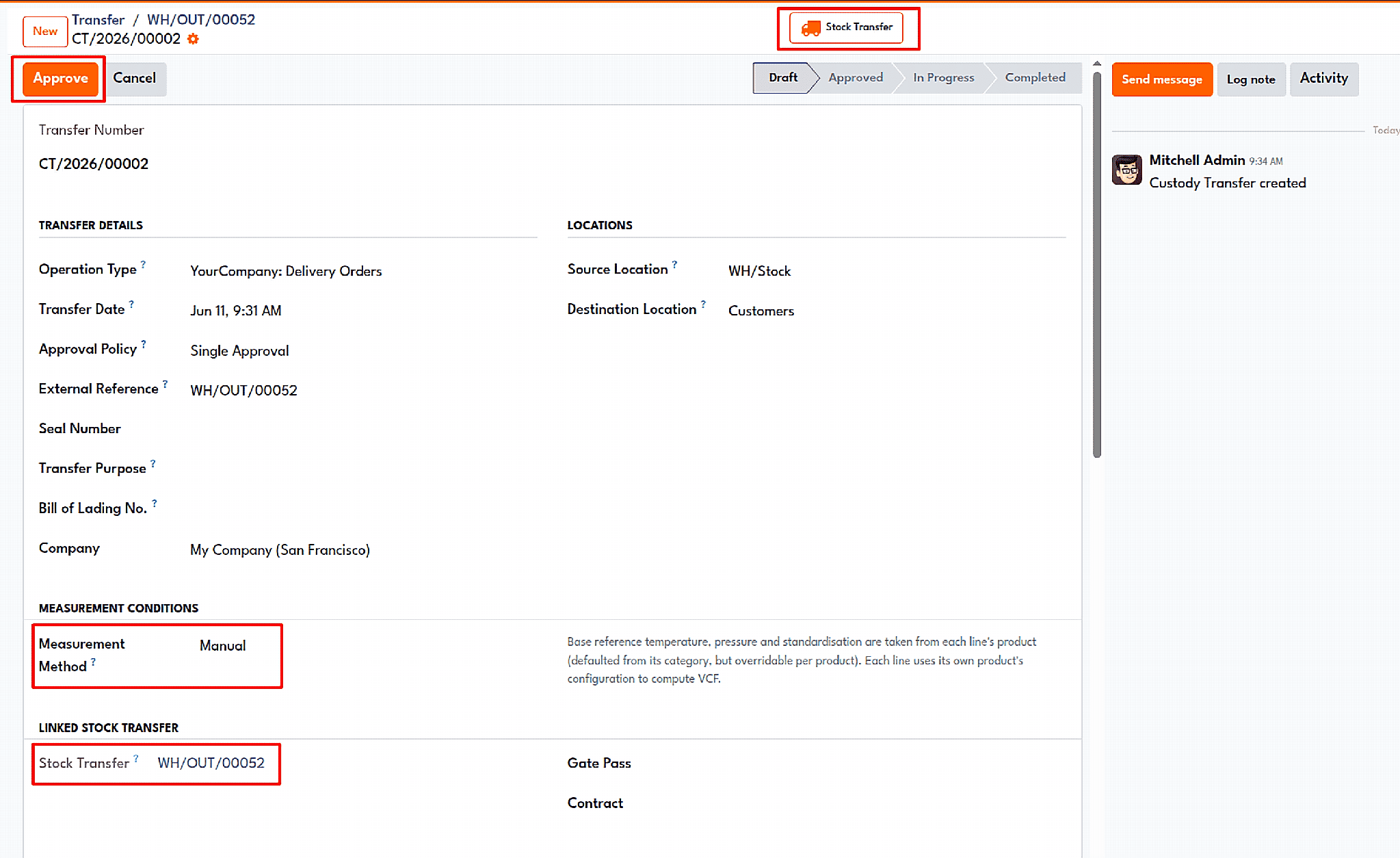
A custody transfer is created from a stock transfer, walking the Draft to Completed approval path.
Fleet & Gate Operations
Fleet Live Tracking establishes a link to the self-hosted Traccar server that features a unified screen displaying all vehicle positions. The fleet's position history is the first thing a customer references in the event of a complaint regarding a hauler who missed a deadline. The pop-up screen indicates the speed, status, and most recent patch. In addition, the Gate Pass module at the terminal gate is in charge of vehicle movement as well as the vehicle inventory. The user is required to enter the vehicle, driver, security check, and the time of the gate in and out so that dropouts at the gate are documented correctly.
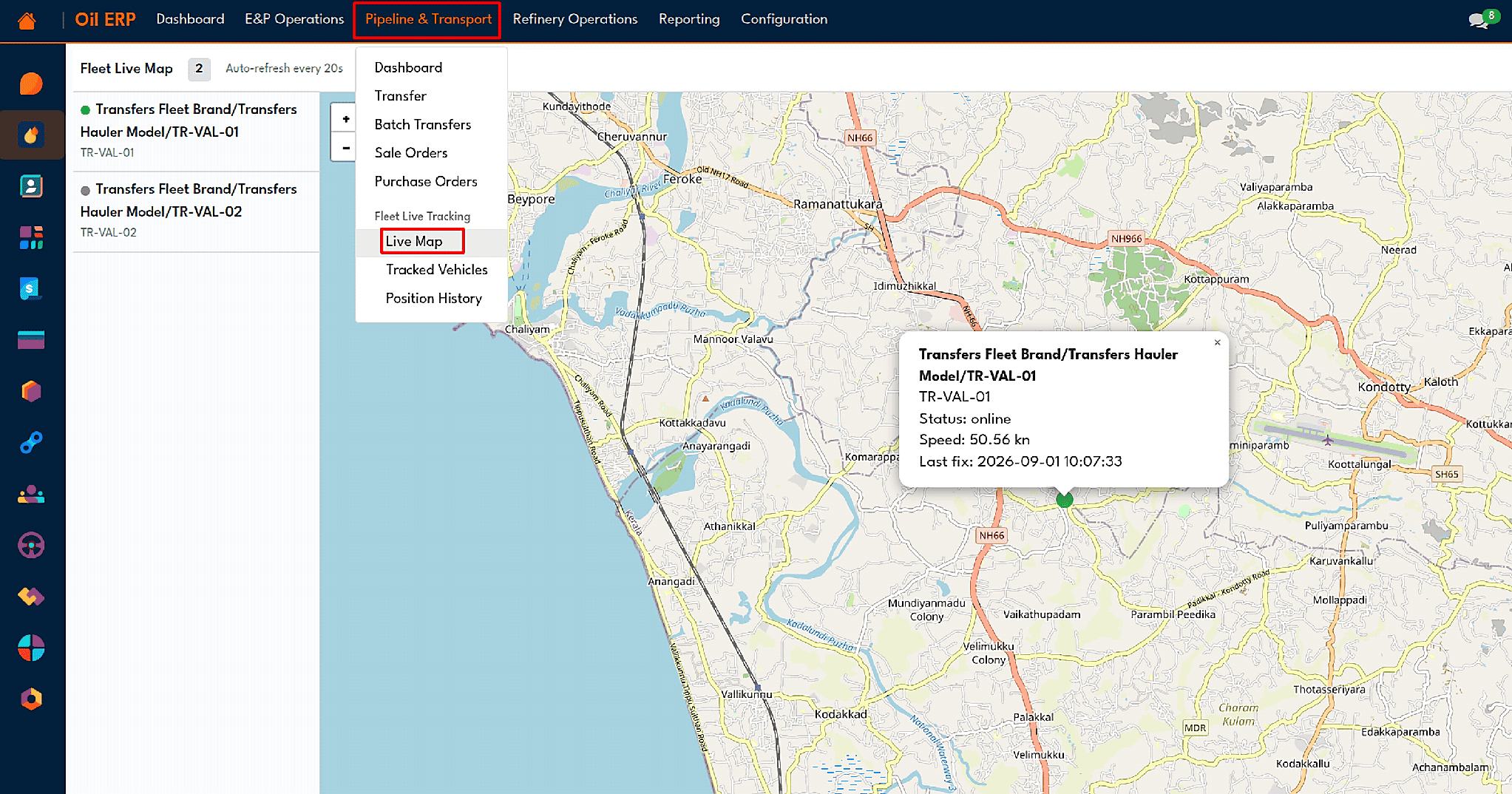
The Fleet Live Map shows hauler positions, speed, and last fix, refreshed automatically.
Downstream: From Crude to Market
Crude is converted into a commodity that consumers can buy later in the chain. At this phase, operations involve converting crude into finished oil products, checking the compliance of each batch, computing output for each refining process, and delivering products to different locations using means such as terminals, trucks, and retail stations. This phase incorporates refining, control of quality, yield management, and distribution of products. The Oil ERP suite stores all processes in the following order: Refinery Operations, Quality Certification, Yield Accounting, Distribution & Dispatch, and Retail Fuel Network.
Refinery Operations
The scene opens at the Refinery Operations dashboard of the suite. Below, we have the status of the manufacturing orders and the top products that are manufactured. At the top, we have active orders in refining, completed orders, orders that have gotten late, pending inspections, failed inspections, and the quality pass rate. So it answers the first three questions of the manager's morning screen before having a coffee.
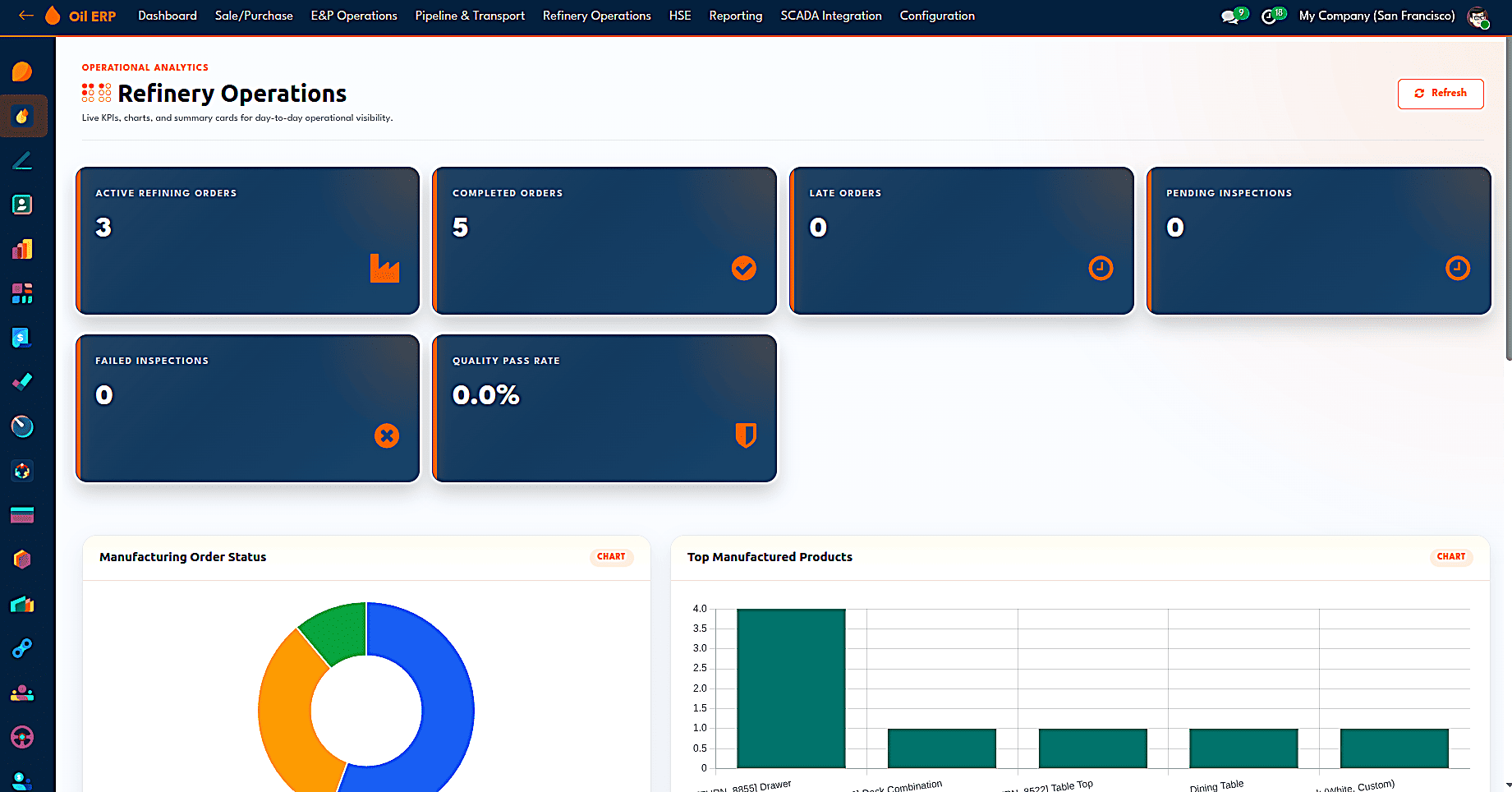
The Refinery Operations dashboard tracks refining orders, inspections and quality pass rate.
Quality Certification
Quality Certification is the responsible body for the operation of the hold-release gate. Each batch that is produced is then compared against the specifications that include test procedures and limits. Based on the results, a Certificate of Analysis is prepared. An example of the CoA given below demonstrates the information included in the CoA, such as measured values and whether those values are acceptable or fail, as seen on the right side of the CoA; the specifications that are being used in the overall process indicated on the left side of the CoA; the method as well as the limitations of the procedure in the middle of the CoA; and the signature of the independent inspector on the left side of the CoA. A predetermined outcome remains valid until a competent individual makes a contrary decision.
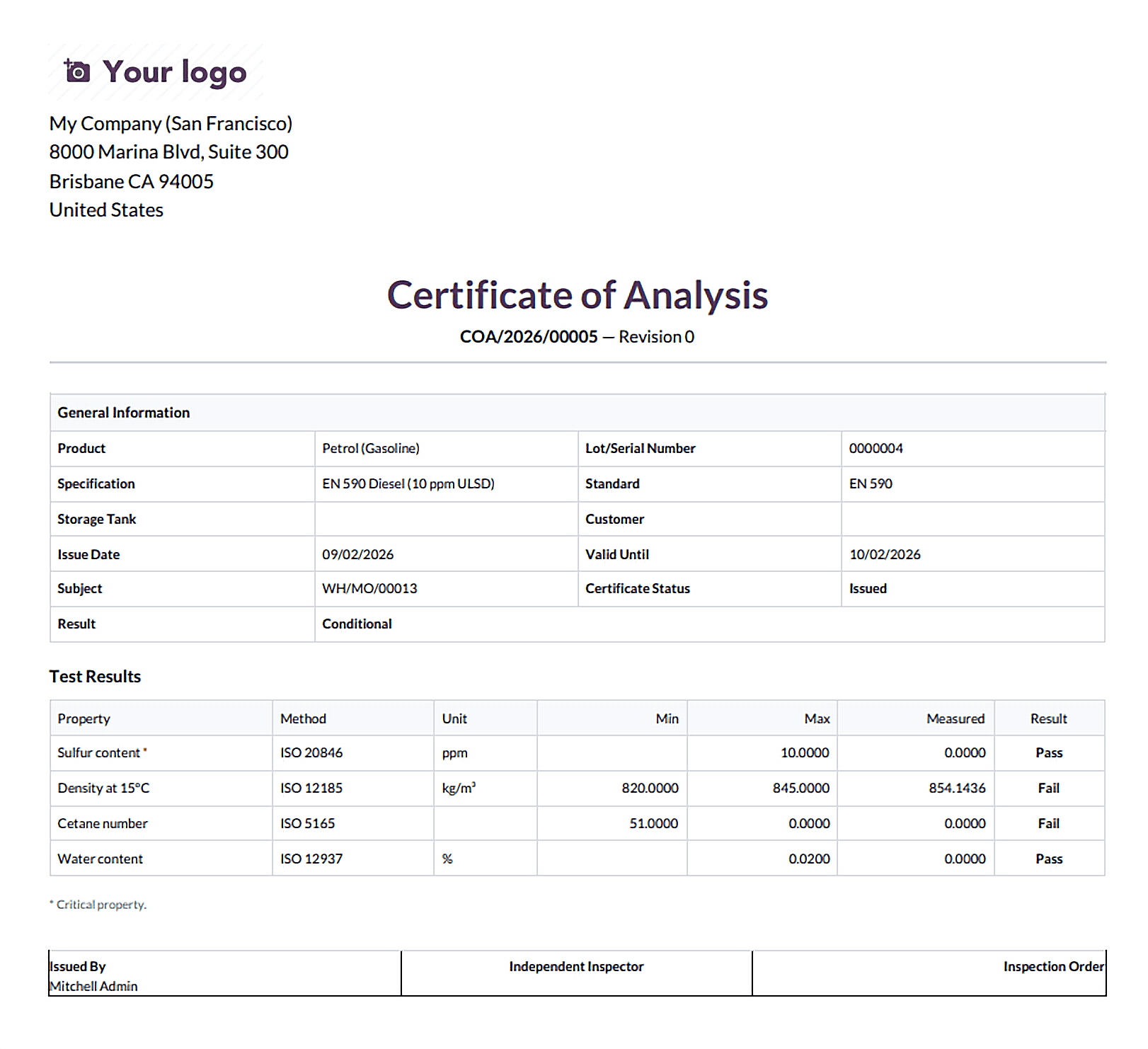
A generated Certificate of Analysis with per-property test results and sign-off blocks.
Yield Accounting
The oldest question asked by the refinery is “Where did the barrels actually go?” This is discussed when yield accounting comes into play. Every production order undergoes an analysis that gives maximum and minimum tolerances, includes a variance column, as well as provides the expected and actual product yield. The number you want flagged is indicated below, which is Critical. Subsequently, yield accounting makes it possible to obtain numbers which previously must go through Submit for Review, thus awaiting Validation.
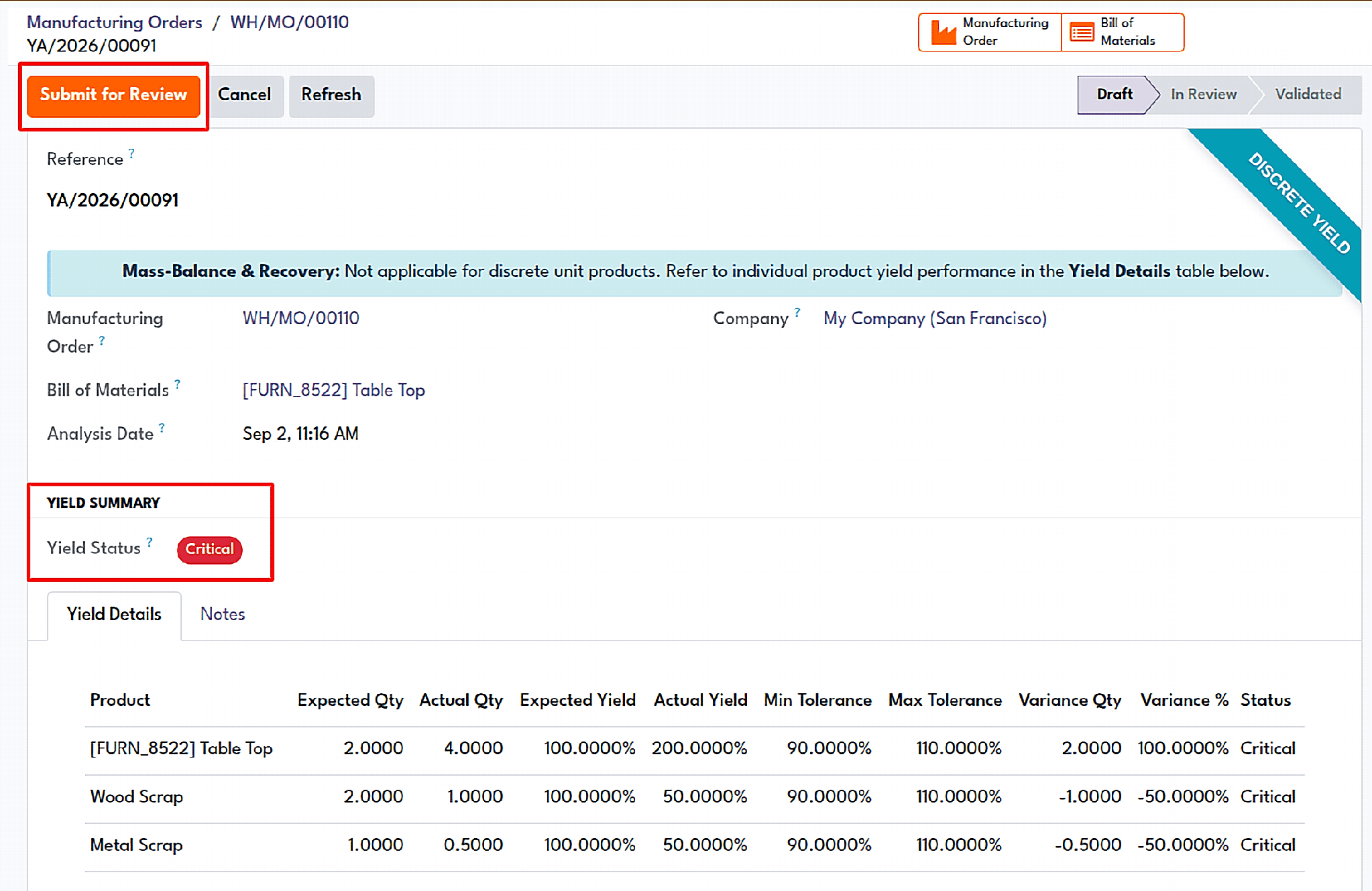
A yield analysis flagging critical variance between expected and actual output for a manufacturing order.
Distribution & Retail
The Distribution & Dispatch component takes on the obligation of delivering fuel to the marketplace. It does this by defining terminals, delivery sites, and paths taken, and it takes into consideration variables like the fuel used, tolls, time taken, and distance travelled. Next, dispatch orders are submitted to stations or customers. The order is then processed from Confirmed to Assigned and then to Trip and Delivered. In gas stations, the Retail Fuel Network component is utilized. Tracking of fuel sales via meters involves keeping track of opening and closing meter readings and tank dips at the end of the day. The journal entry recording the previous routes taken and the final stop of the barrel has been linked in the sales logs, and the logs then get posted in the sales journal.
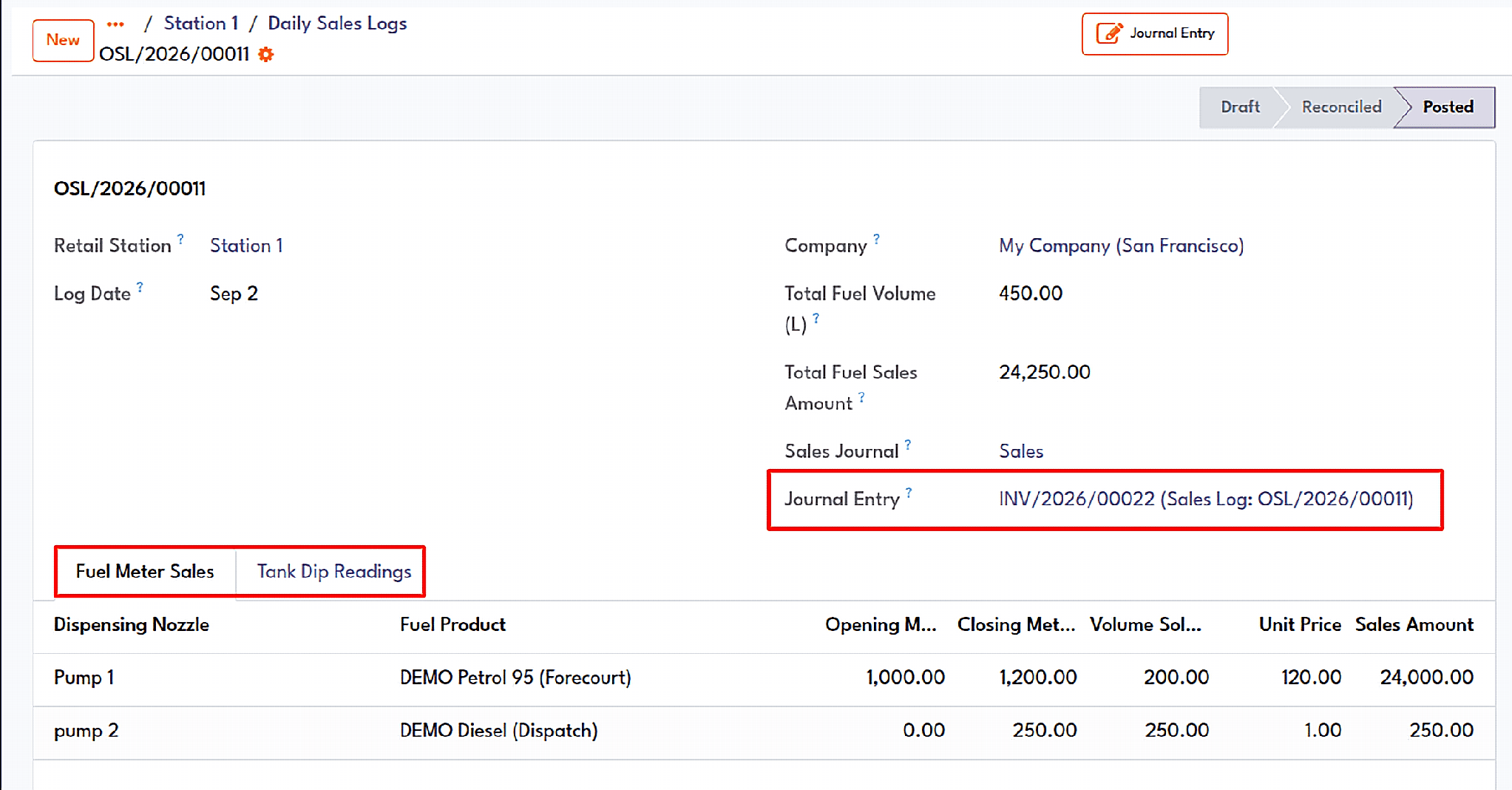
A daily sales log captures pump meter sales and posts them into the sales journal.
HSE: The Thread Through All of It
The module is not associated with a particular section because each significance pertains to the three sections of the module. The HSE dashboard presented below includes an overview of risk categorization and severity along with the information on high-risk activities, upcoming inspections, work permits issued, and incidents that occurred in the last 30 days. The same incident procedure is related to incidents that occur on well sites, permits for pipe-laying crews working, and inspections of refineries. The weather module controls current conditions for wells and drilling designs and allows the owner to suspend the work permits if thresholds are breached and activate them again after good weather comes. The ESG module is responsible for the environment.
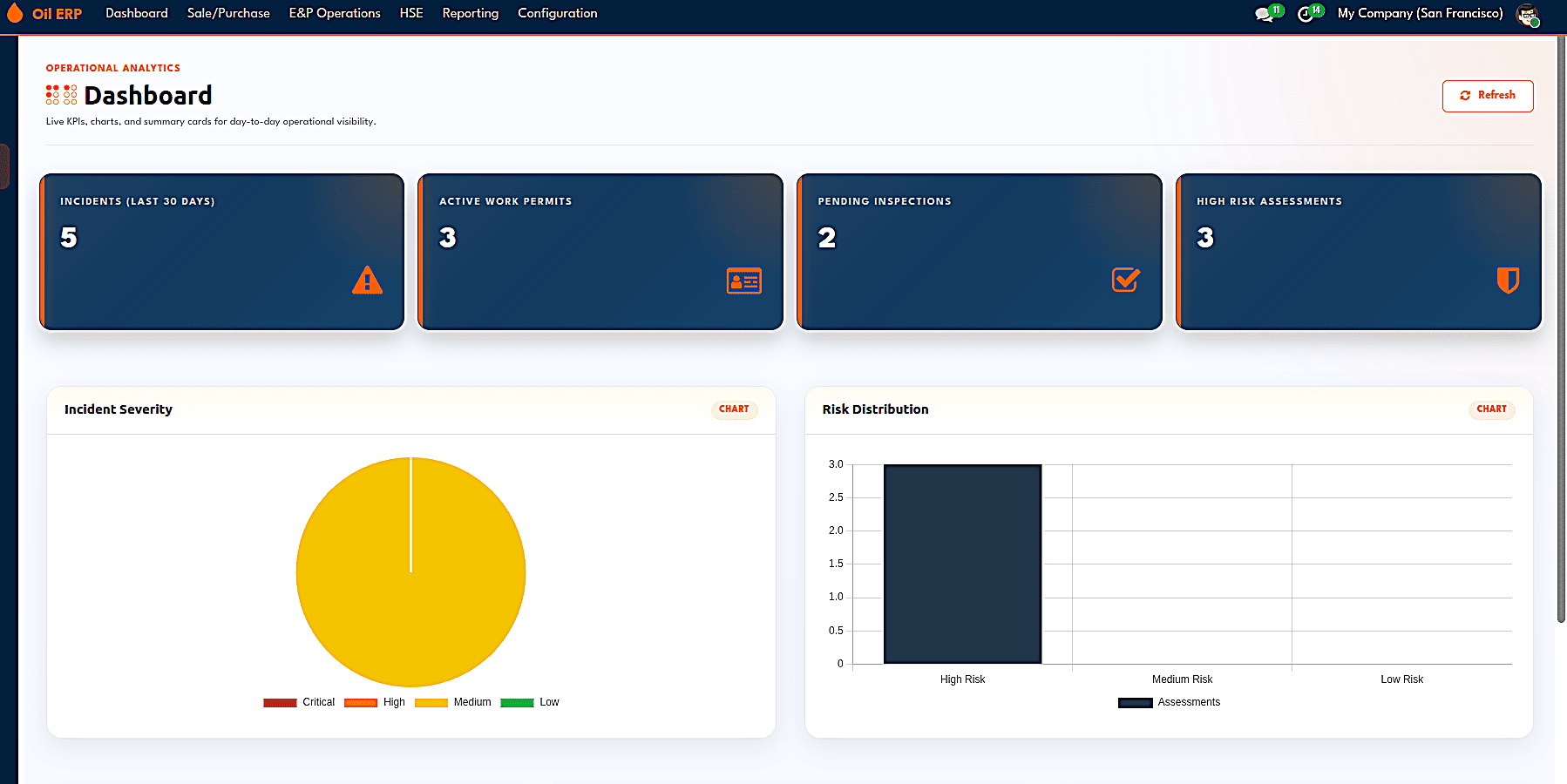
The HSE dashboard consolidates incidents, work permits, inspections, and risk assessments.
How Oil ERP Connects the Complete Value Chain?
The previous section has analyzed the chained operations. The final part of the discussion has outlined the uses of upstream operations such as reservoirs, wells, drilling, SCADA, production optimization, leasing, royalties, and joint ventures; midstream processes, for instance, include fleet tracking, pipelines, transfers, custody transfer, and gate passes, among many others; and finally, the downstream practices, including production, quality certification, yield accounting, distribution, and retail of fuel. HSE, ESG, inspections, equipment, and AI have all been integrated into Odoo accounting software.
The modules that are rolled out from one settings page include E&P Operations, Pipeline & Transport, and Downstream Operations and Sustainability. As soon as you check off the boxes that are relevant for you, all of the possibilities will come up. You will have everything as a single focus where you can see the market price of natural gas and the price of Brent and WTI. You will also see the list with prices for refined products, which can be searched for, and the latest energy news on one side of the website. Thus, the person who organizes the deliveries for the next day will not have to open another tab on their browser to check what happened to Crude overnight - even though it does not seem to be a big deal.
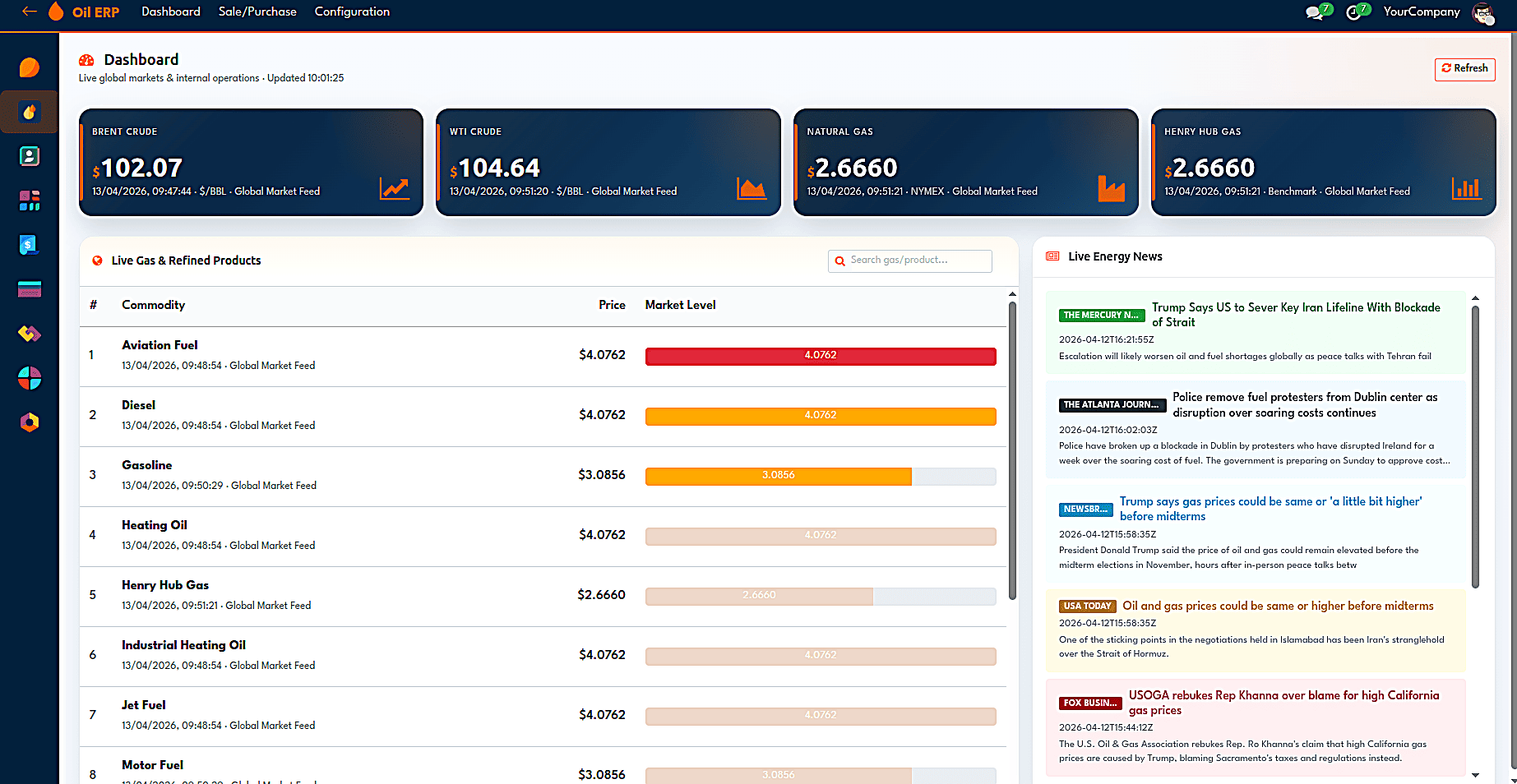
The Oil ERP dashboard with live market prices, refined product feed and energy news.
When the three levels of a respective model can verify each other's figures, upstream finds their numbers, midstream moves their numbers, and downstream offers the product, the whole barrel is intelligible. You can begin with the smallest steps by activating the core module, which includes the common settings, theme, and security group configuration. When the company is fully ready, all other parts of the software can be activated. Each module has its own benefits, which are called a set of a customer list, a product list, books, and a barrel that is able to be tracked from the reservoir until the pump where it was sold.
To read more about What Is Oil ERP? A Complete Beginner’s Guide, refer to our blog What Is Oil ERP? A Complete Beginner’s Guide.